
Sarasota County veterans with multiple service-connected conditions routinely receive combined VA disability ratings that are significantly lower than the sum of their individual ratings, not because of error, but because of a calculation method the VA calls "whole-person math" that few veterans are ever clearly explained. Understanding how that system works is the first step toward knowing whether your current rating accurately reflects your disabilities and what your options are if it does not.
VA Math: Why Your Combined Rating Is Almost Always Lower Than You Expect
How the VA Calculates Combined Disability Ratings
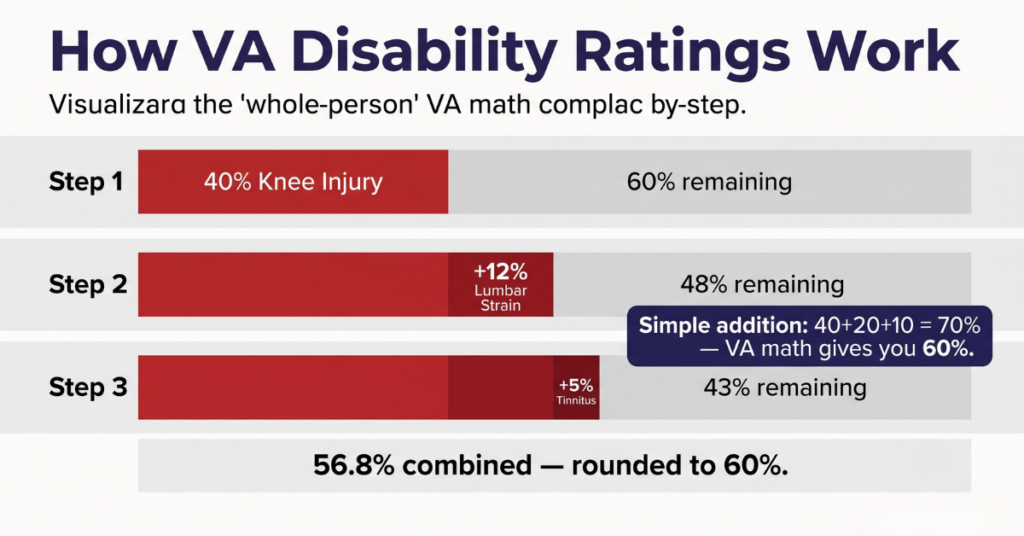
The VA does not add disability percentages together the way most people assume. Instead, it applies each rating to the veteran's remaining "whole person" after the previous disability has already been accounted for. This is the core of what veterans commonly call "VA math."
Here is a worked example using three separate ratings:
| Step | Condition | Individual Rating | Remaining Whole Person |
|---|---|---|---|
| 1 | Knee injury | 40% | 60% remaining |
| 2 | Lumbar strain | 20% of remaining 60% = 12% | 48% remaining |
| 3 | Tinnitus | 10% of remaining 48% = 4.8% | 43.2% remaining |
| Combined Disability | 56.8% - rounded to 60% | Not 70% as simple addition would suggest | |
The VA rounds the final combined value to the nearest 10% increment. In this example, a veteran with three separate conditions totaling 70% by simple addition receives a combined rating of 60%. The difference is not a mistake. It is the intended result of the whole-person calculation method.
The VA's official explanation of how disability ratings are calculated is available at va.gov/disability/about-disability-ratings, and further detail on the rating system is covered in the VA disability ratings bulletin.
Why the Rating Order Matters
The VA applies ratings from highest to lowest, which means the most significant disability consumes the largest share of the whole person first. Veterans with one dominant condition and several smaller ones will typically see the greatest compression in their combined rating.
This is not a flaw in the system, it is a design choice. But it does mean that veterans who file conditions individually over time, rather than comprehensively at once, may end up with a combined rating that does not fully reflect the cumulative impact of all their service-connected conditions.
The Most Common Reasons Sarasota County Veterans Are Underrated
The calculation method explains part of the gap between what veterans expect and what they receive. But there are additional, correctable reasons why Sarasota County veterans are underrated that have nothing to do with the math itself.
- Incomplete medical documentation. VA raters assess what is in the record. Conditions that are real but underdocumented in service treatment records or post-service medical files are routinely rated lower than they should be. Nexus letters from treating physicians, documents that establish the connection between a current condition and military service, are often the deciding factor in a rating decision and are frequently missing from initial claims.
- Missed secondary conditions. Secondary service connection applies when a service-connected condition causes or aggravates another condition. A veteran rated for a knee injury who develops chronic lower back pain from altered gait may qualify for secondary service connection on the back, but only if the connection is documented and claimed. Many veterans do not know to pursue secondary conditions at all.
- Claims filed without VSO representation. Veterans who file claims independently, without the support of an accredited Veterans Service Organization representative or VA-accredited claims agent, are statistically more likely to receive lower ratings on initial decisions. Accredited representatives know which evidence is required, how to frame claims, and how to anticipate VA rater objections before a decision is made.
- Ratings that have not kept pace with worsening conditions. A rating assigned five years ago may not reflect a veteran's current level of impairment. Veterans whose conditions have worsened can file for an increase, but many do not know this is an option or assume their rating is final.
What a Rating Review Actually Involves
Veterans who believe their current rating does not accurately reflect their disabilities have several options under the VA's decision review process. The three primary pathways are a Higher-Level Review, a Supplemental Claim with new evidence, and a Board of Veterans' Appeals hearing. Each has different timelines, evidence requirements, and strategic considerations.
The right pathway depends on the specific circumstances of the original claim decision. For most veterans, working with an accredited VSO representative is the most reliable approach; these representatives are trained specifically in VA claims processes, charge no fee for claims representation, and have institutional knowledge of what regional VA offices respond to.
Full information on available review options is at va.gov/decision-reviews. A complete overview of disability compensation eligibility and benefits is at va.gov/disability.
Where SRQ Vets Fits In: Support While the System Catches Up
VA claims and appeals take time. Higher-Level Reviews average several months. Board appeals can take years. During that window, veterans in Sarasota County who are waiting on a rating decision or appeal outcome may face real financial pressure — utility bills, vehicle repairs, housing costs, that cannot wait for the VA timeline.
SRQ Vets provides direct, practical assistance to veterans in exactly that situation. Vehicle repairs, utility support, mobility modifications, and resource navigation are available to veterans across Sarasota County who need help now, regardless of where they are in the VA claims process.
You can find a full overview of available assistance and how to access it at the SRQ Vets resource hub. For answers to specific questions about what support is available while a VA claim is pending, the Sarasota County veteran support FAQ covers the most common situations veterans face during the claims process.
Frequently Asked Questions
Why is my combined VA disability rating lower than the sum of my individual ratings?
The VA uses a whole-person calculation method rather than simple addition. Each disability rating is applied to the veteran's remaining able-bodied percentage after the previous rating has already been accounted for. This means multiple conditions always produce a combined rating lower than their sum. The VA then rounds the final combined value to the nearest 10% increment. This calculation method is standard and applies to all veterans regardless of location or branch of service.
Can I request a higher VA disability rating if my condition has worsened?
Yes. Veterans whose service-connected conditions have worsened since their original rating can file for an increase by submitting a Supplemental Claim with new medical evidence documenting the current level of impairment. There is no penalty for requesting a rating increase, and the effective date for an approved increase is typically the date the new claim was filed. Working with an accredited VSO representative is strongly recommended for any rating increase request.
What is a secondary service connection and how do I claim it?
A secondary service connection applies when a service-connected condition causes or aggravates another condition that would not otherwise qualify as service-connected on its own. For example, a veteran service-connected for a knee injury who develops chronic back problems due to altered gait may be able to claim the back condition as secondary. To establish secondary service connection, you typically need a medical nexus opinion from a treating physician linking the secondary condition to the primary service-connected condition.
What can I do if my VA disability claim was denied or I believe my rating is too low?
Veterans have three formal review options: a Higher-Level Review (reviewed by a more senior VA adjudicator), a Supplemental Claim with new and relevant evidence, or an appeal to the Board of Veterans' Appeals. Each pathway has different timelines and requirements. Information on all three options is available at va.gov/decision-reviews. Working with an accredited VSO representative at no cost is the most reliable approach for any appeal or rating challenge.
Your rating should reflect the full impact of your service. If it does not, you have options, and you do not have to navigate them alone.